Tradition for over a hundred years
The year 1363 holds special significance for the Rechenhof inn. In this historic year, the land of Tyrol was transferred from the princely dynasty of the "Meinhardiner" to the Habsburgs, and the Rechenhof, situated above Mühlau, was first mentioned in official records as "Reachhof".
Who doesn't know it — the idyllically located inn on the sunny plateau above Innsbruck. For generations, the "Rechenhof" has been one of the most popular excursion destinations for the people of Innsbruck. Known as an "oasis of tranquility" in Innsbruck's local recreation area, it holds a top spot in the hearts of stress-weary visitors.
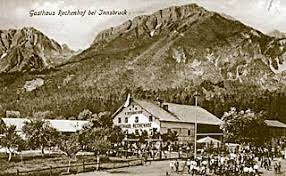
And there is good reason for this: Visiting hikers appreciate not only the unique panorama of the Inn Valley's mountain landscape, but
also the ambiance of this traditional establishment, which the Speckbacher family offers its guests.
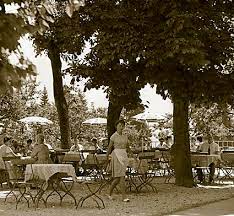
The inn is renowned for its wonderful cuisine and its rich selection of homemade "delicacies", which can be enjoyed either in the beer
garden in fine weather or in the cozy parlors.
Moreover, the light-flooded "Salettl" is extremely popular for wedding parties and other events, from seminars to corporate
celebrations.
That the Rechenhof is an ideal starting point for hikes and mountain tours is known not only to locals but also to tourists. For decades, the Speckbacher family has hosted guests from all over the world in their house.
Eventful history of the Rechenhof
The building, now over 640 years old, breathes history.
It was built in 1363 by the Habsburgs as a hunting lodge. The noble family had an animal enclosure built next to the residence for
deer breeding. And from this, the name Rechenhof, which was colloquially known as "Reachhof", can be derived.
Until 1898, the building was continuously in imperial possession, during which time it was transferred to feudal lords of the Habsburgs for management. "Among the most prominent guests who stayed overnight in the hunting lodge — which even housed a chapel — are, besides countless regional princes, undoubtedly Emperor Maximilian, who was a passionate hunter," recounts senior owner Heinz Speckbacher from the history of the house.
The last feudal lord, whose name has been forgotten, acquired the property from the Habsburgs and began serving drinks for the first time shortly before the turn of the century.
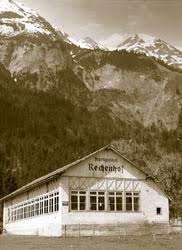
In 1902, my great-grandfather, Alois Speckbacher, bought the farm. He came from Gnadenwald and was a direct descendant of the famous Tyrolean freedom hero Josef Speckbacher, who died in 1820. His main focus was on farming; the inn was merely a "sideline". To this day, a wall clock he commissioned still draws admiration in the dining room. In 1906, he had a veranda built, which was a special feature for that era, Heinz Speckbacher is delighted about his ancestors' achievements.
Closely linked to the first major boom for the inn was the Hungerburgbahn, opened on September 12, 1906, and the construction of the Rosnerweg, completed in 1908, which to this day provides an ideal connection between the Hungerburg and the Rechenhof. The path, named after the then chairman of the Innsbruck Beautification Society, Prof. Johann Rosner, remains one of Innsbruck's most beautiful hiking trails. Furthermore, Italian prisoners of war from the First World War built a path from Mühlau to the Rechenhof, which was extremely popular as a hiking trail in summer and subsequently as a toboggan run in winter until the 1960s. The end of the toboggan run came with sand spreading to ensure traffic safety.
The law of the series
After Alois Speckbacher passed away in 1917, his son Max was responsible for the fortunes of the inn until he lost his life in a
tragic accident in 1956. Speckbacher: "None of my ancestors died of natural causes. Josef Speckbacher was fatally injured at work. My
grandfather Alois was kicked by a horse in the Mühlau gorge and fatally struck, and my father Max was crushed against the house wall
while a truck was reversing. As fate would have it, all three died at the age of 57.
This gave me pause on my 57th birthday, and I was particularly careful that year. But the law of the series stopped at three," Heinz
Speckbacher is happy to report.
In 1959, Heinz Speckbacher took over the business, which had been run in the interim by his mother Johanna. Unfortunately, the
Rechenhof, as once before in 1880, was completely devastated on September 21, 1972, by a hay self-combustion that broke out in the
adjacent hay barn.
At that time, I decided to subject the building to a complete renovation and expansion.
For the past 15 years, son Werner, the fourth generation, has been dedicated to the well-being of the guests and upholds the traditions of his ancestors. "To keep our regular customers satisfied, we must keep the house in 'top condition'. That's why I refurbished the guest rooms to the latest standards ten years ago and built the 'Salettl', a new pavilion for daily business, in 1998," the passionate innkeeper enthuses about his establishment.
The innkeeper receives vigorous support from his mother Maria, who cares for the culinary well-being of the guests.
Werner Speckbacher is particularly proud of his newly built wine cellar beneath the Salettl, whose entrance is lined with the paneling and inlays of the former veranda. "Here our guests are invited to wine tastings in a cozy setting. After enjoying our optimally stored premium wines, it can sometimes happen that 'closing time' is considerably exceeded," Speckbacher chuckles.
Werner Speckbacher is optimistic about the future.
The regular clientele is pampered by the tried-and-tested Rechenhof cuisine and remains loyal to the historic house on the sunny
plateau. I'm particularly pleased to see the children of older guests now vacationing with us. I've noticed that not everyone wants to
holiday in Mallorca or Ibiza. The Rechenhof is a traditional establishment, and we try to satisfy our guests with good, down-to-earth
offerings and a fair price-performance ratio. We want to remain a normal, rural excursion inn."
This is appreciated. There is no shortage of prominent guests even today. The fact that a member of the Habsburg family, Franz Habsburg-Lothringen, with his daughters and wife has chosen the Rechenhof as a holiday home again and again for years, proves more than anything else that history lives on.
(Walter Mair)